Thursday, March 5, 2026

The entire Hawaii Island chain consists of about 132 islands and atolls, but Hawaii, as we know it, consists of only eight islands or which only seven are permanently inhabited. The Islands are as follows from largest to smallest: Big Island, Maui, Oahu, Kauai, Molokai, Lanai, Kaloolawe, and Niihau. Hawaii is located 3,860km (2400 miles) of the coast of California. Hawaii’s populutation after the Census of 2000 was 1,211,537.

Quick Facts

2020 Estimated Population (US Census): 1.45 Million
Male:50.1%
Female:49.9%
2018 Estimated Population (US Census): 1.42 Milliion
2010 Census Population: 1.36 Million

2024 Population (ACS)
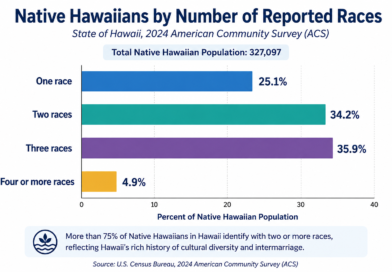
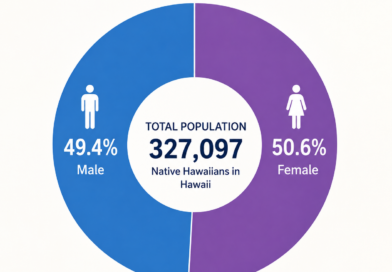
Native Hawaiian Population: 327,097
Male: 49.4%
Female: 50.6%
Foreign Born Population: 268,845
Male: 43.4%
Female: 56.6%

Hawaii 1884 census

A summary of the 1884 hawaii census, showing population details across different categories and offering insight into the islands demographics.

Read More »

Hawaii 1878 Census

The 1878 census shows distinct differences in age ranges, sex ratios, ethnic makeup, and foreign-born origins across Hawaiʻi’s populated islands, offering a clear view of how each island’s population differed during that period.

Read More »

Hawaii 1866 Census

This post looks at how Hawaiʻi’s population was recorded in 1866, focusing on the way people were grouped and counted in the historical census of that year.

Read More »

Hawaii 1860 Census

The 1860 census recorded individuals according to age, sex, and marital status, giving a framework for understanding the population’s composition during that time.

Read More »

Hawaii 1853 Census

The 1853 census of the Hawaiian Islands expanded on earlier counts by including age, sex, marital status, disabilities, and religious affiliation. It offers a broader view of Hawaiian society, showing how families, social roles, and personal characteristics were distributed across the population during this time.

Read More »

Hawaii 1849 Census

The 1849 census of the Hawaiian Islands provides one of the earliest detailed looks at the Native Hawaiian population. It organizes people by age groups and gender, giving a clear picture of how the population was distributed across children, young adults, adults, and elders during this period.

Read More »

Views: 5603